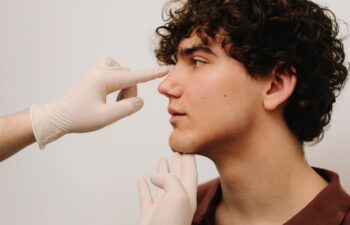
The nose is one of the most defining features of the male face — and one of the most consequential surgical decisions a man can make. When male patients research rhinoplasty, they frequently encounter before-and-after galleries that don’t match their goals, consultations where they feel their concerns about maintaining a masculine appearance aren’t fully understood, and results on other men that look overdone, feminized, or simply unlike the person was before. These outcomes aren’t the result of rhinoplasty being the wrong choice for men. They’re the result of rhinoplasty being performed without an adequate understanding of what masculine nasal aesthetics actually require.
At Simply Males in Beverly Hills, Dr. David Sayah has built his practice specifically around the principle that men are not female patients with different names — they have different facial geometry, different aesthetic goals, different proportional ideals, and different definitions of what a successful result looks like. Male rhinoplasty, performed correctly, is not a female procedure adapted for a male patient. It is a distinct surgical approach that begins with a completely different set of aesthetic principles.
The Male Nose: What Masculine Aesthetic Goals Actually Look Like
The ideals that guide female rhinoplasty — a refined, slightly upturned tip, a subtle supra-tip break, a gracefully narrowed bridge, a softened profile — produce the kind of result that reads as cosmetically altered on a male patient. The masculine nose has different defining characteristics that a skilled surgeon preserves and enhances rather than eliminates.
The male nose typically projects more prominently from the face. The dorsum — the bridge — has more substance and definition, often with a slight dorsal hump that, on a masculine face, reads as strength rather than imperfection. The nasal tip is broader and less refined than on a feminine nose, providing the angular definition that is characteristic of male facial geometry. The angle between the base of the nose and the upper lip — the nasolabial angle — is typically 90 to 95 degrees in men, compared to 95 to 110 degrees in women. A nose that sits at the female angle on a male face reads as immediately and obviously feminized.
These are not minor calibration differences. They are the fundamental parameters that determine whether a rhinoplasty result looks like a better version of the male patient’s face or like a feminized alteration of it.
What Happens When Standard Techniques Are Applied to Male Patients
The most consistent pattern Dr. Sayah sees in revision consultations at Simply Males involves men who had rhinoplasty at practices where male-specific aesthetics were not the surgical foundation. The results they describe — a nose that looks small relative to their face, a tip that looks pinched or over-refined, a profile that has lost the structural definition that characterized their appearance — are the predictable outcome of female-oriented techniques applied to a male anatomy.
The problem isn’t that the procedures were technically imperfect. Often the surgery was executed with genuine skill. The problem is that the target was wrong from the beginning. Reducing a male patient’s dorsal hump to a flat, straight profile removes the feature that reads as masculine definition on that face. Refining and rotating the tip beyond the male aesthetic range produces a nose that is anatomically smaller but facially incongruous. Over-narrowing the bridge creates a nose that looks fragile and inconsistent with the rest of the facial architecture.
Correction of these results is more complex than the original surgery — which is the primary reason to get the male aesthetic calibration right from the first procedure.
Dr. Sayah’s Approach to Male Rhinoplasty
The consultation process at Simply Males begins with a specific and detailed analysis of male facial proportions — the relationship between the nose, the brow, the chin, and the overall skeletal frame that determines what nasal changes will look harmonious versus incongruous. Dr. Sayah uses this analysis to identify the specific changes that will enhance the patient’s appearance in a distinctly masculine direction, and to identify the specific features that should be preserved because they contribute to the facial character that makes the patient look like himself.
This includes preserving appropriate dorsal projection, maintaining or creating angular tip definition rather than feminine refinement, calibrating the nasolabial angle to male norms, and ensuring that any size reduction maintains proportions consistent with the patient’s facial frame. For men who want a straighter profile without feminizing the result, the technique involves different degrees of reduction and different shaping approaches than the same aesthetic goal pursued on a female patient.
Dr. Sayah’s 15+ years of surgical experience, his fellowship training in advanced endoscopic techniques, and his exclusive focus on male patients at Simply Males produce a specific form of clinical calibration that comes only from operating on male faces with male aesthetic goals as the consistent standard.
The Male Rhinoplasty Patient: Who Is a Good Candidate
Men who seek rhinoplasty most commonly have concerns that fall into several categories: a nasal bridge that appears too wide or too prominent in a way that affects facial proportion, a tip that projects or droops in a way that is visible in profile, asymmetry that draws the eye, or nasal trauma that has affected both appearance and function. Functional concerns — a deviated septum causing obstruction, breathing impairment — are frequently addressed concurrently with cosmetic changes.
The consultation at Simply Males evaluates both dimensions explicitly and develops a surgical plan that addresses the patient’s specific concerns without overreaching into changes that would alter the masculine character of the face.
Schedule Your Consultation at Simply Males
Dr. David Sayah and the Simply Males team welcome consultations for men throughout Beverly Hills, Los Angeles, and the surrounding area, as well as patients traveling from outside California. Virtual consultations are available for men who want to begin the process remotely. The office is located in Beverly Hills. Call (310) 928-0920 to schedule your consultation — and have the conversation about rhinoplasty with a surgeon whose standard of success is specifically calibrated to the male face.
Posted on behalf of
436 North Bedford Drive Suite 202
Beverly Hills, CA 90210
Phone: (310) 928-0920